Not all explanations are created equal. For an explanation to be useful in practice, it must do more than highlight inputs or display weights. It needs to behave reliably and reflect how the model actually works.
Academic Writing, Data Science, My Digital Universe, Portfolio

Why Consistency and Faithfulness Matter in AI Explanations

In the growing field of explainable AI, tools like LIME and SHAP have made it possible to peek inside complex models and understand their reasoning. But just because a model can explain itself doesn’t mean every explanation is meaningful or trustworthy.

Evaluating the Quality of Explanations

Not all explanations are created equal. For an explanation to be useful in practice, it must do more than highlight inputs or display weights. It needs to behave reliably and reflect how the model actually works.

Two critical properties help assess that:

1. Consistency

A good explanation should behave consistently. That means:

  • If you train the same model on different subsets of similar data, the explanations should remain relatively stable.
  • Small changes to input data shouldn’t lead to dramatically different explanations.

Inconsistent explanations can confuse users, misrepresent what the model has learned, and signal overfitting or instability in the model itself.

2. Faithfulness

Faithfulness asks a simple but powerful question: Do the features highlighted in the explanation actually influence the model’s prediction?

An explanation is not faithful if it attributes importance to features that, when changed or removed, don’t affect the outcome. This kind of misleading output can erode trust and create false narratives around how the model operates.

Why These Metrics Matter

In sensitive applications like healthcare, lending, or security, misleading explanations are more than just technical flaws. They can have real-world consequences.

  • Imagine a credit scoring model that cites a user’s browser history or favorite color as key decision drivers. Even if the model is technically accurate, such explanations would damage its credibility and raise ethical and legal concerns.
  • In regulated industries, explanations that fail consistency or faithfulness checks can expose organizations to compliance risks and reputational damage.

Real-World Examples

Faithfulness Test: Credit Risk Model

A faithfulness test was applied to a credit risk model used to classify applicants as “high” or “low” risk. The SHAP explanation highlighted feature A (e.g., number of bank accounts) as highly important.

To test faithfulness, this feature was removed and the model’s prediction didn’t change … at all!
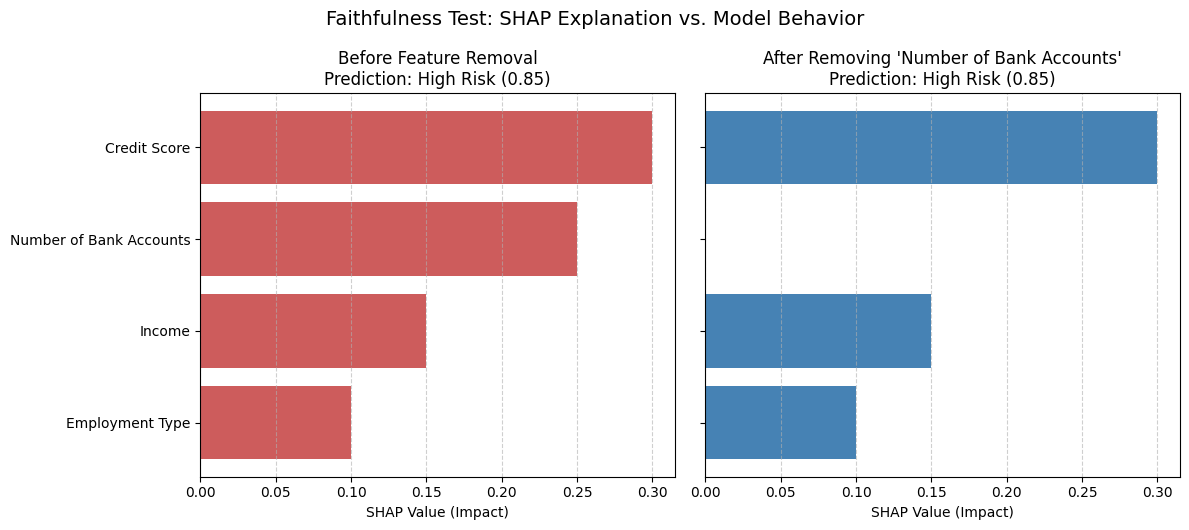
What the graph shows:

  • SHAP value for “Number of Bank Accounts” was +0.25 (suggesting a major contribution).
  • But after removing it, the model’s risk prediction stayed the same, proving that this feature wasn’t actually influencing the output.

This revealed a serious problem: the model was producing unfaithful explanations. It was surfacing irrelevant features as important, likely due to correlation artifacts in the training data.

Consistency Test: Credit Risk Model

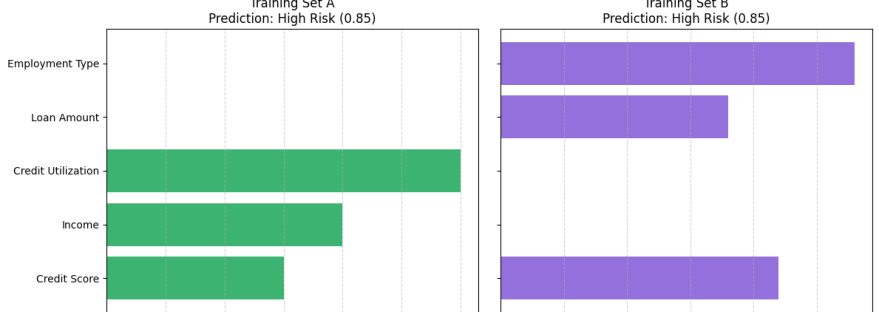
A credit scoring model was trained on two different but similar subsets of loan application data. Both versions produced the same prediction for an applicant: “high risk”, but gave very different explanations.
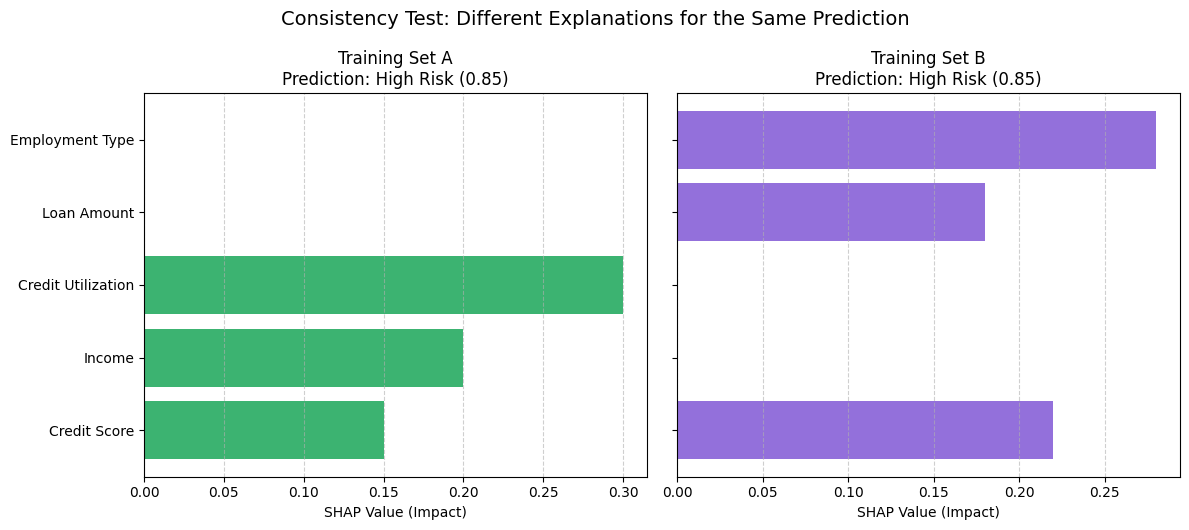
What the graph shows:

  • In Training Set A, the top contributing feature was “Credit Utilization” (+0.3).
  • In Training Set B, it was “Employment Type” (+0.28).
  • The SHAP bar charts for the same applicant looked noticeably different, even though the final decision didn’t change.

This inconsistency raised questions about model stability: Can we trust that the model is learning the right patterns, or is it too sensitive to the training data?

Final Thoughts

As AI systems continue to make critical decisions in our lives, explainability is not a luxury, it’s a necessity. Tools like LIME and SHAP offer a valuable window into how models work, but that window needs to be clear and reliable.

Metrics like consistency and faithfulness help us evaluate the strength of those explanations. Without them, we risk mistaking noise for insights, or worse, making important decisions based on misleading information.

Accuracy might get a model deployed, but consistency and faithfulness should decide its validity and trust. If you want to learn more about explainability in AI, please check this blog post, where I talk about how LIME and SHAP can help explain model outcomes.

Understanding Model Decisions with SHAP and LIME
Academic Writing, Data Science, My Digital Universe

What Made the Model Say That? Real Examples of Explainable AI

When people talk about artificial intelligence, especially deep learning, the conversation usually centers around accuracy and performance. How well does the model classify images? Can it outperform humans in pattern recognition? While these questions are valid, they miss a crucial piece of the puzzle: explainability.

Explainability is about understanding why an AI model makes a specific prediction. In high-stakes domains like healthcare, finance, or criminal justice, knowing the why is just as important as the what. Yet this topic is often overlooked in favor of performance benchmarks.

Why Is Explainability Hard in Deep Learning?

Classical models like decision trees (e.g., CART) offer built-in transparency. You can trace the decision path from root to leaf and understand the model’s logic. But deep learning models are different. They operate through layers of nonlinear transformations and millions of parameters. As a result, even domain experts can find their predictions opaque.

This can lead to problems:

  • Lack of trust from users or stakeholders
  • Difficulty debugging or improving models
  • Potential for hidden biases or unfair decisions

This is where explainability tools come in.

Tools That Help Open the Black Box

Two widely used frameworks for model explanation are LIME (Local Interpretable Model-agnostic Explanations) and SHAP (SHapley Additive exPlanations). Both aim to provide insights into which features influenced a specific prediction and by how much.

LIME in Action

LIME works by perturbing the input data and observing how the model’s predictions change. For instance, in a text classification task, LIME can highlight which words in an email led the model to flag it as spam. It does this by creating many variations of the email (e.g., removing or replacing words) and observing the output.

Loan Risk Example:

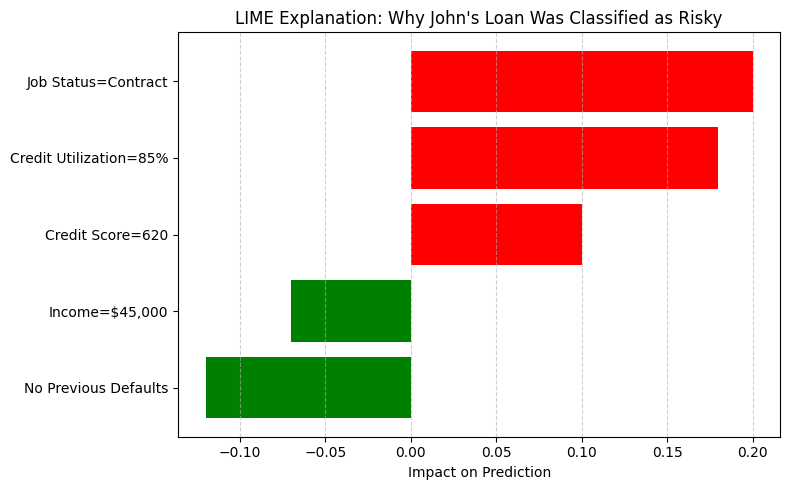
  • A model classifies a loan application as risky. We will use John as an example.
  • We want to find the reasons as to why their application was labeled as risky.
  • LIME reveals that the applicant’s job status and credit utilization were the two most influential factors.

LIME reveals that the model flagged John’s loan as risky mainly due to his contract employment status and high credit utilization. Although John had no previous defaults and a moderate income, those factors were outweighed by the others in the model’s decision.

SHAP in Practice

SHAP uses concepts from cooperative game theory to assign each feature an importance value. It ensures a more consistent and mathematically grounded explanation. SHAP values can be plotted to show how each input feature pushes the prediction higher or lower.

Medical Diagnosis Example:

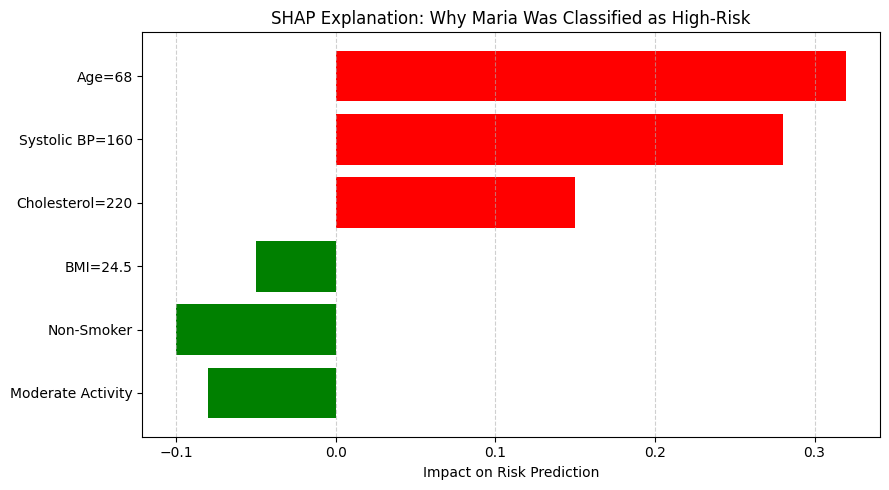
  • Let’s use Maria as an example, after her information was entered into the system, she was classified as high risk by the model
  • To understand as to what factors contributed to that classification, we can use SHAP. SHAP shows that age and blood pressure significantly contributed to a high-risk prediction.
  • These insights help physicians verify if the model aligns with clinical reasoning.

Final Thoughts

The examples of Maria and John illustrate a powerful truth: even highly accurate models are incomplete without explanations. When a model labels someone as high-risk, whether for a disease or a loan default, it’s not enough to accept the outcome at face value. We need to understand why the model made that decision.

Tools like LIME and SHAP make this possible. They open up the black box and allow us to see which features mattered most, giving decision-makers the context they need to trust or challenge the model’s output.

Why Explainability Matters in Business:

  • Builds trust with stakeholders
  • Supports accountability in sensitive decisions
  • Uncovers potential biases or errors in the model
  • Aligns predictions with domain expertise

As AI becomes more embedded in real-world systems, explainability is not optional; it’s essential. It turns predictions into insights, and insights into informed, ethical decisions.

Good AI model evaluations doesn’t stop at explainability. Learn the importance of consistency and faithfulness and see why it matters by checking out this post.