Conflict-free scheduling: Ensures no two vehicles with intersecting paths enter at the same time.
Academic Writing, Data Science, My Digital Universe, Portfolio

Optimizing Traffic Flow: Efficient, but Is It Safe?

Unsignalized intersections are managed without traffic lights. They rely on stop signs and right-of-way rules. These intersections are inherently riskier compared to traffic light enforced ones because now there is no lights and it depends on the driver paying attention to the stop sign, but that is a different matter altogether.

They’re common in suburban or low-traffic areas but increasingly challenged by growing traffic volumes and the emergence of Connected and Automated Vehicles (CAVs).

These intersections are friction points in modern traffic systems. And the problem often starts with one outdated rule: First-Come-First-Served (FCFS).

First-Come-First-Served

FCFS is a simple scheduling principle: vehicles cross in the order they arrive. If multiple vehicles approach, each waits for the ones ahead (yes, you are supposed to wait if the other person arrives at the stop sign before you) even if their paths don’t conflict.

Why It Falls Short

  • No spatial awareness: Vehicles wait even when their paths don’t intersect. This may not be a bad thing if your city or neighborhood has CRAZY drivers but it is not efficient right?
  • Ignores vehicle dynamics: No speed adjustments are used to reduce waiting time. Although you may be able to reply to a text or two? NO. Don’t text and drive!
  • Creates bottlenecks: Delays increase when vehicles arrive from different directions in quick succession. Oh well, your precious time.

In the animation above, each vehicle waits for the previous one to clear the intersection, even when there’s no collision risk. The result? Wasted time and unused intersection space. Well, that is if you only care about efficiency. Not so bad from a safety point of view.

Why FCFS Doesn’t Work for CAVs

As vehicles become more intelligent and connected, relying on a static rule like FCFS is inefficient. This is assuming that the person behind the wheel is also intelligent enough to practice caution and obey traffic rules and drives SOBER.

Modern CAVs can:

  • Share real-time location and speed data.
  • Coordinate with one another to avoid collisions.
  • Adjust their behavior dynamically.

FCFS fails to take advantage of these capabilities. It often causes unnecessary queuing, increasing delays even when safe, efficient crossings are possible through minor speed changes. Again, assuming that the drivers are all outstanding citizens with common sense, yes, this is not very efficient and there is room for improvement.

A Smarter Alternative: Conflict-Free, Real-Time Scheduling

This recent paper, named “An Optimal Scheduling Model for Connected Automated Vehicles at an Unsignalized Intersection” proposes a linear programming-based model to optimize flow at unsignalized intersections. The model is built for CAVs and focuses on minimizing average delay by scheduling optimal crossing times based on:

  • Vehicle location and direction
  • Potential conflict zones

Key Features of the Model

  • Conflict-free scheduling: Ensures no two vehicles with intersecting paths enter at the same time.
  • Rolling horizon optimization: Continuously updates schedules in real time.
  • Delay minimization: Vehicles adjust speed slightly instead of stopping.

In this visualization, vehicles coordinate seamlessly:

  • The red car enters first.
  • The gray car slows slightly to avoid a conflict.
  • The blue car times its approach to maintain flow.

No stopping. No wasted time. Just optimized motion.

Now that all sounds good to me. It sounds somewhat like a California Stop, if you know what I mean. But how can we trust the human to obey these more intricate optimization suggestions when people don’t even adhere to more simple rules like slowing down in a school zone? Ok, maybe a different topic. So let’s assume that these are all goody goodies behind the wheel and continue.

Performance: How the Model Compares to FCFS

According to the study’s simulations:

  • Up to 76.22% reduction in average vehicle delay compared to FCFS.
  • Real-time responsiveness using rolling optimization.
  • Faster computation than standard solvers like Gurobi, making it viable for live deployment.

The result? Smoother traffic, shorter waits, and better use of intersection capacity without traffic signals.

Rethinking the Rules of the Road

FCFS is simple but simplicity comes at a cost. In a connected, data-driven traffic ecosystem, rule-based systems like FCFS are no longer sufficient.

This study makes the case clear: real-time, model-based scheduling is the future of unsignalized intersection management. As cities move toward CAVs and smarter infrastructure, the ability to optimize traffic flow will become not just beneficial, but essential. That said, complexity also comes at a cost. If all the vehicles are autonomous and are controlled by a safe, optimized, and centralized algorithmic command center, this could work. But as soon as you introduce free agency, which is not a bad thing, but in this context it introduces a lot of risk, randomness, uncertainty, and CHAOS … one have to think about efficiency vs. practicality and safety.

If these CAVs are able to enter into a semi-controlled environment when they enter the parameter of the intersection, perhaps this approach could work. This means that while they are in the grid (defined by a region that leads up to the stop sign), the driver does loose some autonomy and their vehicle will be simulated by a central command … this might be a good solution to implement.

Either way, this is an interesting study. After all, we all want to get from point A to point B in the most efficient way possible. The less time we spend behind the wheel at stop signs, the more time we have for … hopefully not scrolling Tik Tok. But hey, even that is better than just sitting at a stop sign, right?


The value of traditional language corpora for pretraining LLMs is plateauing, making it necessary to gather new, challenging data to improve performance on language and reasoning tasks.
Academic Writing, Data Science, Portfolio

Agentic LLMs: The Evolution of AI in Reasoning and Social Interaction

The landscape of artificial intelligence is evolving every second. Large Language Models (LLMs) are evolving from passive entities into active, decision-making agents. This shift introduces agentic LLMs. Now, we have all seen people metnion agentic this, agentic that, the last few months. In essence, these systems are endowed with reasoning abilities, interfaces for real-world action, and the capacity to engage with other agents. These advancements are poised to redefine industries such as robotics, medical diagnostics, financial advising, and scientific research.

The Three Pillars of Agentic LLMs

  1. Reasoning Capabilities At the heart of agentic LLMs lies their reasoning ability. Drawing inspiration from human cognition, these systems emulate both rapid, intuitive decisions (System 1 thinking) and slower, analytical deliberation (System 2 thinking). Current research predominantly focuses on enhancing the decision-making processes of individual LLMs.
  2. Interfaces for Action Moving beyond static responses, agentic LLMs are equipped to act within real-world environments. This is achieved through the integration of interfaces that facilitate tool usage, robotic control, or web interactions. Such systems leverage grounded retrieval-augmented techniques and benefit from reinforcement learning, enabling agents to learn through interaction with their environment rather than relying solely on predefined datasets.
  3. Social Environments The third component emphasizes multi-agent interaction, allowing agents to collaborate, compete, build trust, and exhibit behaviors akin to human societies. This fosters a social environment where agents can develop collective intelligence. Concepts like theory of mind and self-reflection enhance these interactions, enabling agents to understand and anticipate the behaviors of others.

A Self-Improving Loop

The interplay between reasoning, action, and interaction creates a continuous feedback loop. As agents engage with their environment and each other, they generate new data for ongoing training and refinement. This dynamic learning process addresses the limitations of static datasets, promoting perpetual improvement.

Here, agents act in the world, generate their own experiences, and learn from the outcomes, without needing a predefined dataset. This approach, used by models from OpenAI and DeepSeek, allows LLMs to capture the full complexity of real-world scenarios, including the consequences of their own actions. Although reinforcement learning introduces challenges like training instability due to feedback loops, these can be mitigated through diverse exploration and cautious tuning. Multi-agent simulations in open-world environments may offer a more scalable and dynamic alternative for generating the diverse experiences required for stable, continual learning.

From Individual Intelligence to Collective Behavior

The multi-agent paradigm extends the focus beyond individual reasoning to explore emergent behaviors such as trust, deception, and collaboration. These dynamics are observed in human societies, and insights gained from these studies can inform discussions on artificial superintelligence by modeling how intelligent behaviors emerge from agent interactions.

Conclusion

Agentic LLMs are reshaping the understanding of machine learning and reasoning. By enabling systems to act autonomously and interact socially, researchers are advancing toward creating entities capable of adaptation, collaboration, and evolution within complex environments. The future of AI lies in harmonizing these elements: reasoning, action, and interaction into unified intelligent agent systems that not only respond but also comprehend, decide, and evolve.

What does this mean for fine tuning LLMs? Well, here is where it gets interesting. Unlike traditional LLM fine-tuning, which relies on static datasets curated from the internet and shaped by past human behavior, agentic LLMs can generate new training data through interaction. This marks a shift from supervised learning to a self-learning paradigm rooted in reinforcement learning.

For an indepth take on agentic LLMs, I highly recommend reading this survey.

LLMS thinking
Data Science, My Digital Universe, Portfolio

What Large Language Models Really Are: Not Minds, Just Math with Tools

LLMs like ChatGPT are often described as if they think. They don’t. At least not qiote like humans. Which, may not be a bad thing given the kind of stuff us humans have conjured up over the years.

Back in 2011, Daniel Kahneman introduced System 1 and System 2 thinking:

  • System 1: fast, intuitive, automatic
  • System 2: slow, deliberate, reasoned

LLMs are pure System 1 engines. They don’t reason. They don’t understand. They predict the next token … that’s it.

Every “intelligent” response is just a string of highly probable guesses. Step by step, word by word. Recent research on Agentic LLMs make this a tad bit interesting.

By plugging LLMs into tools for reasoning, retrieval, symbolic logic, interaction, we build the appearance of System 2 thinking:

  • Step-by-step prompting
  • Calling calculators or search engines
  • Planning with external tools
  • Interacting with other agents

This isn’t true deliberation. It’s orchestration. We’re layering deliberate behavior on top of probabilistic word prediction.

The magic of modern LLMs isn’t intelligence. It’s composition, blending fast token prediction with structured workflows and external tools. They’re not minds. They’re language interfaces made powerful through math, scale, and tool use.

Understanding this doesn’t undercut them. It makes us better at using them.

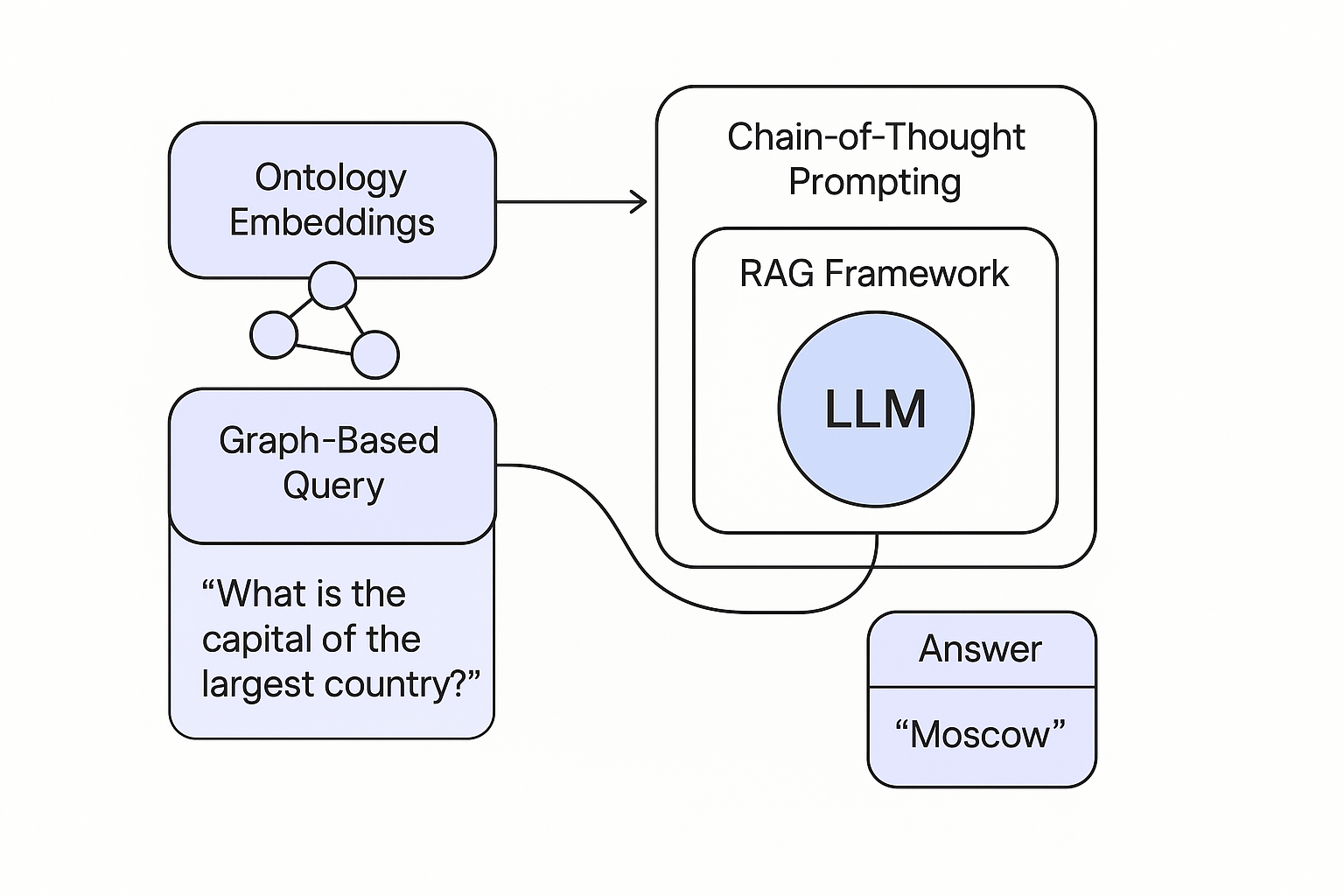
Diagram illustrating how a large language model (LLM) answers questions using ontology embeddings, Chain-of-Thought prompting, and Retrieval-Augmented Generation from a knowledge graph.
Academic Writing, Data Science, My Digital Universe, Portfolio

Revolutionizing Data Interaction: How AI Can Comprehend Your Evolving Data Without Retraining

In the rapidly evolving landscape of enterprise AI, organizations often grapple with a common challenge: enabling large language models (LLMs) to interpret and respond to queries based on structured data, such as knowledge graphs, without necessitating frequent retraining as the data evolves.

A novel approach addresses this issue by integrating three key methodologies:

  1. Ontology embeddings : Transform structured data into formats that LLMs can process, facilitating an understanding of relationships, hierarchies, and schema definitions within the data.
  2. Chain-of-Thought prompting: Encourage LLMs to engage in step-by-step reasoning, enhancing their ability to navigate complex data structures and derive logical conclusions.
  3. Retrieval-Augmented Generation (RAG): Equip models to retrieve pertinent information from databases or knowledge graphs prior to generating responses, ensuring that outputs are both accurate and contextually relevant.

By synergizing these techniques, organizations can develop more intelligent and efficient systems for querying knowledge graphs without the need for continuous model retraining.

Implementation Strategy

  • Combining Ontology Embeddings with Chain-of-Thought Prompting: This fusion allows LLMs to grasp structured knowledge and reason through it methodically, which is particularly beneficial when dealing with intricate data relationships.
  • Integrating within a RAG Framework: Traditionally used for unstructured data, RAG can be adapted to retrieve relevant segments from knowledge graphs, providing LLMs with the necessary context for informed response generation.
  • Facilitating Zero/Few-Shot Reasoning: This approach minimizes the need for retraining by utilizing well-structured prompts, enabling LLMs to generalize across various datasets and schemas effectively.

Organizational Benefits

Adopting this methodology offers several advantages:

  • Reduced Need for Retraining: Systems can adapt to evolving data without the overhead of continuous model updates.
  • Enhanced Explainability: The step-by-step reasoning process provides transparency in AI-driven decisions.
  • Improved Performance with Complex Data: The model’s ability to comprehend and navigate structured data leads to more accurate responses.
  • Adaptability to Schema Changes: The system remains resilient amidst modifications in data structures.
  • Efficient Deployment Across Domains: LLMs can be utilized across various sectors without domain-specific fine-tuning.

Practical Applications

This approach has been successfully implemented in large-scale systems, such as the Dutch national cadastral knowledge graph (Kadaster), demonstrating its viability in real-world scenarios. For instance, deploying a chatbot capable of:

  • Understanding domain-specific relationships without explicit programming.
  • Updating its knowledge base in tandem with data evolution.
  • Operating seamlessly across departments with diverse taxonomies.
  • Delivering transparent and traceable answers in critical domains.

Conclusion

By integrating ontology-aware prompting, systematic reasoning, and retrieval-enhanced generation, organizations can develop AI systems that interact with structured data more effectively. This strategy not only streamlines the process but also enhances the reliability and adaptability of AI applications in data-intensive industries. For a comprehensive exploration of this methodology, refer to Bolin Huang’s Master’s thesis.

A visual representation of a Knowledge Graph Question Answering (KGQA) framework that integrates ontology embeddings, Chain-of-Thought prompting, and Retrieval-Augmented Generation (RAG). The diagram shows the flow from user query to LLM reasoning and response generation based on structured data from a knowledge graph.
"Comparison of traditional time series models like ARIMA with foundation models like TimesFM, SigLLM, and GPT-based anomaly detection approaches"
Academic Writing, Data Science, My Digital Universe, Portfolio

Time Series + LLMs: Hype or Breakthrough?

Time series foundational models like UniTS and TimesFM are trained on massive, diverse datasets and show promising results in anomaly detection. Surprisingly, even general-purpose LLMs (like GPT) can detect anomalies effectively; without any domain-specific pretraining.

But here’s the reality check:

🔹 LLMs are not always superior to traditional models like ARIMA. In fact, classical statistical models still outperform them in some cases—especially when data is clean and patterns are well-understood.

🔹 Pretrained pipelines like Orion reduce the cost of training from scratch, enabling faster deployment. However, real-time efficiency remains a challenge.

🔹 SigLLM, which converts time series into text for LLM input, is innovative—but rolling window representations make it computationally expensive.

🔹 Despite limitations like context window size and slow inference, LLMs are still flexible enough to be competitive. But they don’t consistently outperform classical models across the board.

👉 The bottom line: LLMs are not a silver bullet. The most effective strategy is often hybrid, combining classical statistical techniques with foundation model strengths.

Are LLMs the future of time series modeling—or just another wave of AI hype?

Let’s discuss.

#AI #TimeSeries #AnomalyDetection #LLMs #FoundationModels
📄 Thesis by Linh K. Nguyen (MIT)